
Mobile App Maintenance Costs: Annual Budgeting & SLA Guide for 2026
Launching your app is just the first mile. Learn why leading companies allocate 15-20% of their initial build budget to ongoing maintenance, OS compatibility, and security patching.
Mr. Vikash Yadav
Co-Founder & CEO, BounceTech Solutions
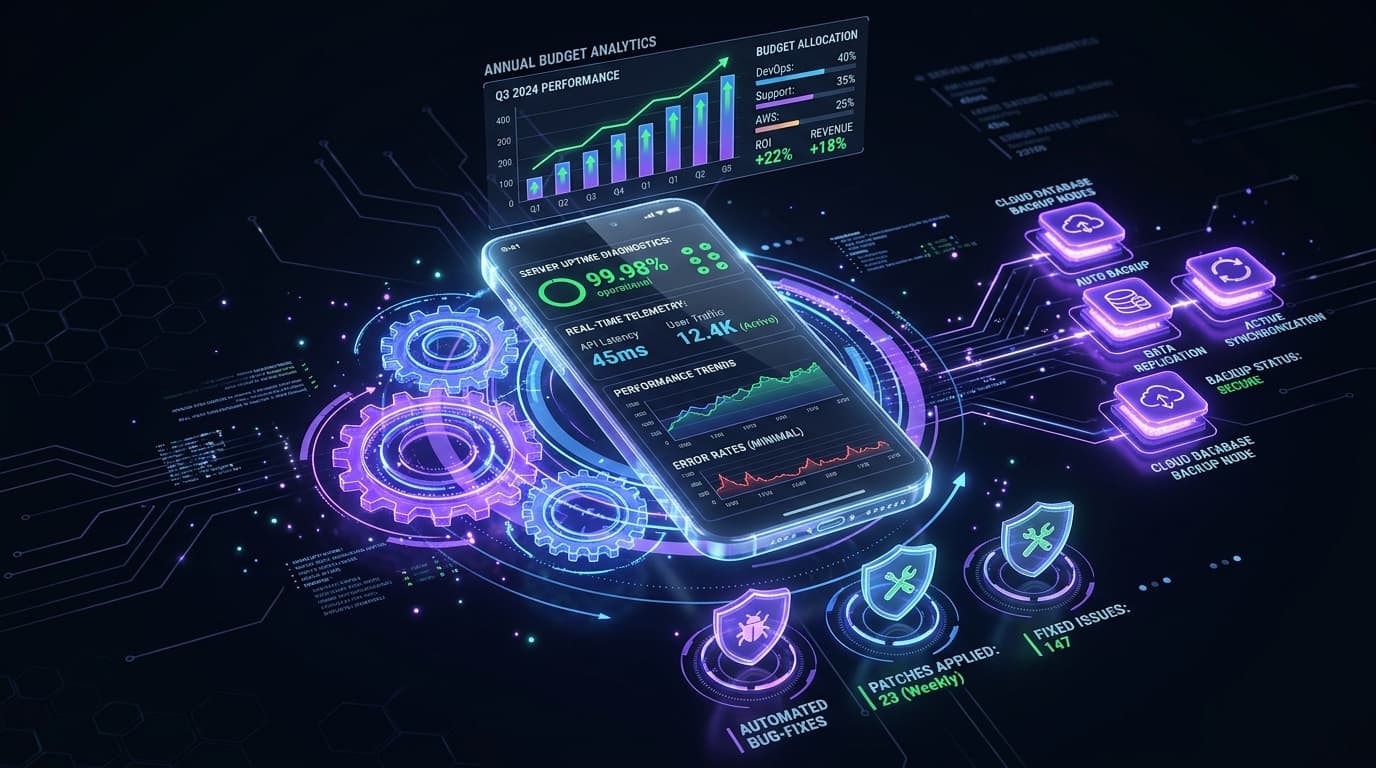
- ✓The universal industry benchmark for mobile app maintenance is 15% to 20% of the initial development cost per year.
- ✓Both Apple and Google enforce mandatory annual target SDK deadlines; apps that fail to update are hidden from search and eventually delisted.
- ✓Ongoing maintenance covers 4 critical pillars: operating system compatibility, cloud server scaling, third-party API deprecations, and cybersecurity patching.
- ✓A structured Service Level Agreement (SLA) with guaranteed response times protects commercial apps from catastrophic downtime and revenue loss.
The 15–20% Rule: What Mobile Maintenance Actually Costs
A common misconception among first-time founders is assuming that software development is a one-time capital expense. In reality, software is a living digital asset. Left unattended, applications degrade due to operating system updates, deprecated library dependencies, and evolving security standards—a phenomenon known in engineering as software rot.
Across the software industry, the standard formula for budgeting application upkeep is the 15% to 20% rule. For an application that costs $60,000 to build, you should reserve between $9,000 and $12,000 annually ($750 to $1,000 per month) for ongoing maintenance and support.
Apple & Google Annual SDK Mandates
Every autumn, Apple releases a major iOS version (iOS 17, iOS 18, etc.) and Google rolls out a new Android version. Along with shiny consumer features, these updates introduce breaking privacy changes, permission shifts, and deprecated APIs:
- Google Play Target API Requirements: Google mandates that all apps must target an API level within one year of the latest Android release. Failing to update prevents you from submitting app updates and restricts new downloads to legacy devices.
- Apple Privacy Manifests: Apple now requires third-party SDK privacy manifests and signed dependencies. Apps omitting these declarations face immediate binary rejections during App Store review.
- Hardware Adaptations: Supporting new display aspect ratios, Dynamic Island features, and folding screen form factors requires iterative UI updates.
The 4 Pillars of Ongoing Mobile App Maintenance
Professional mobile maintenance encompasses four critical engineering workflows:
- Corrective Maintenance (Bug Fixing): Identifying and patching real-world crashes flagged by Firebase Crashlytics or Sentry across thousands of fragmented device models and screen sizes.
- Adaptive Maintenance (OS & Dependency Upgrades): Upgrading Flutter or React Native SDKs, updating third-party libraries (CocoaPods/Gradle), and ensuring compatibility with latest OS patches.
- Perfective Maintenance (Performance Tuning): Optimizing database query times, reducing app memory usage, decreasing battery drain, and improving cold-boot launch speeds.
- Preventative Maintenance (Security Audits): Rotating expired SSL certificates, auditing JWT token expiration logic, updating backend packages with known CVE vulnerabilities, and database backups.
Cloud Backend, Push Notifications & Third-Party APIs
In addition to developer labor, recurring third-party subscriptions must be factored into your operational runway:
| Service Category | Popular Providers | Estimated Monthly Cost (10k Users) |
|---|---|---|
| Cloud Database & Compute | AWS, Google Cloud, Supabase | $75 – $350 / mo |
| Push Notifications | OneSignal, Firebase FCM | $0 – $99 / mo |
| Crash Reporting & Telemetry | Sentry, Datadog | $29 – $120 / mo |
| In-App Purchase Management | RevenueCat, Qonversion | $0 – $119 / mo |
SLA Tiers: Retainer vs On-Demand Support
Companies manage maintenance through two contractual vehicles:
1. Monthly Retainer SLA (Recommended): You purchase a set block of dedicated engineering hours (e.g., 20 to 40 hours/month). The development team actively monitors server uptime, applies weekly security patches, and guarantees a rapid turnaround (e.g., 2-4 hour response time for critical severity bugs).
2. On-Demand / Ad-Hoc Billing: You only engage developers when an issue breaks. While this avoids a monthly recurring fee, developers may be occupied with other client sprints, leading to prolonged downtime and high emergency hourly rates.
Explore our transparent Mobile App & Software Maintenance SLA Packages to protect your digital product post-launch.
Annual Maintenance SLA Service Levels
Compare standard agency SLA support models to match your operational risk profile:
| SLA Tier | Dedicated Hours | Critical Bug Response | Included Scope | Monthly Investment |
|---|---|---|---|---|
| Bronze Care | 10 hrs / mo | Within 24 Hours | Server uptime monitoring, quarterly security patches. | $650 / mo |
| Silver Business | 25 hrs / mo | Within 8 Hours | Annual OS SDK updates (iOS 18/Android 15), bug patches, APM review. | $1,500 / mo |
| Gold Enterprise | 50 hrs / mo | Within 2 Hours (24/7) | Continuous sprint iterations, weekly releases, dedicated DevOps engineer. | $2,900 / mo |
Questions People Frequently Ask
How much does it cost to maintain a mobile app each year?
Annual mobile app maintenance typically costs between 15% and 20% of the initial development cost. If your application cost $50,000 to build, expect to budget $7,500 to $10,000 annually ($600 to $850 per month) for OS upgrades, bug fixes, server infrastructure, and security patches.
What happens if I don't maintain or update my mobile app?
If you do not update your app, Apple and Google will flag it as 'abandoned' when new OS versions launch (e.g., iOS 18/Android 15). Google and Apple require apps to target recent SDK levels within 12 months, or the app will be hidden from search results and eventually delisted.
What is included in a dedicated mobile app maintenance SLA?
A professional maintenance SLA includes guaranteed response times (e.g., critical bugs resolved within 4 hours), 24/7 uptime monitoring, server OS patching, database backups, dependency upgrades, and crash analytics reviews using tools like Sentry and Firebase Crashlytics.
Written by Engineering Expert
Mr. Vikash Yadav
Vikash leads business strategy and digital product transformation at BounceTech Solutions, partnering with global startups and mid-market enterprises to engineer high-performing software systems.
Keep Reading
Related Articles & Guides
 Cloud Computing
Cloud Cost Optimization (AWS & DevOps): How to Reduce Cloud Spend by 30-50% Without Sacrificing Performance
An engineering guide to auditing AWS infrastructure, rightsizing compute resources, eliminating idle cloud waste, and lowering cloud spend by up to 50%.
 Mobile App Development
 Cost in 2026: Complete Pricing & Budgeting Guide
From $18,000 MVPs to $160,000+ enterprise platforms, explore the definitive breakdown of mobile app development costs across iOS, Android, and cross-platform frameworks.
 SaaS
SaaS MVP Development: How to Plan, Build, and Launch in 90 Days
A battle-tested 90-day blueprint for founders and product teams to validate, design, develop, and launch a successful SaaS MVP.
Turn these architectural insights into reality.
Partner with BounceTech Solutions for custom software development, telemedicine apps, SaaS MVPs, and scalable cloud systems.