
Native vs Cross-Platform App Development: Performance, Cost & Tech Guide
Should you build separate Swift and Kotlin apps, or unify under Flutter or React Native? We compare real-world frame rates, hardware integrations, and 3-year Total Cost of Ownership.
Mr. Prakash Yadav
Co-Founder & CTO, BounceTech Solutions
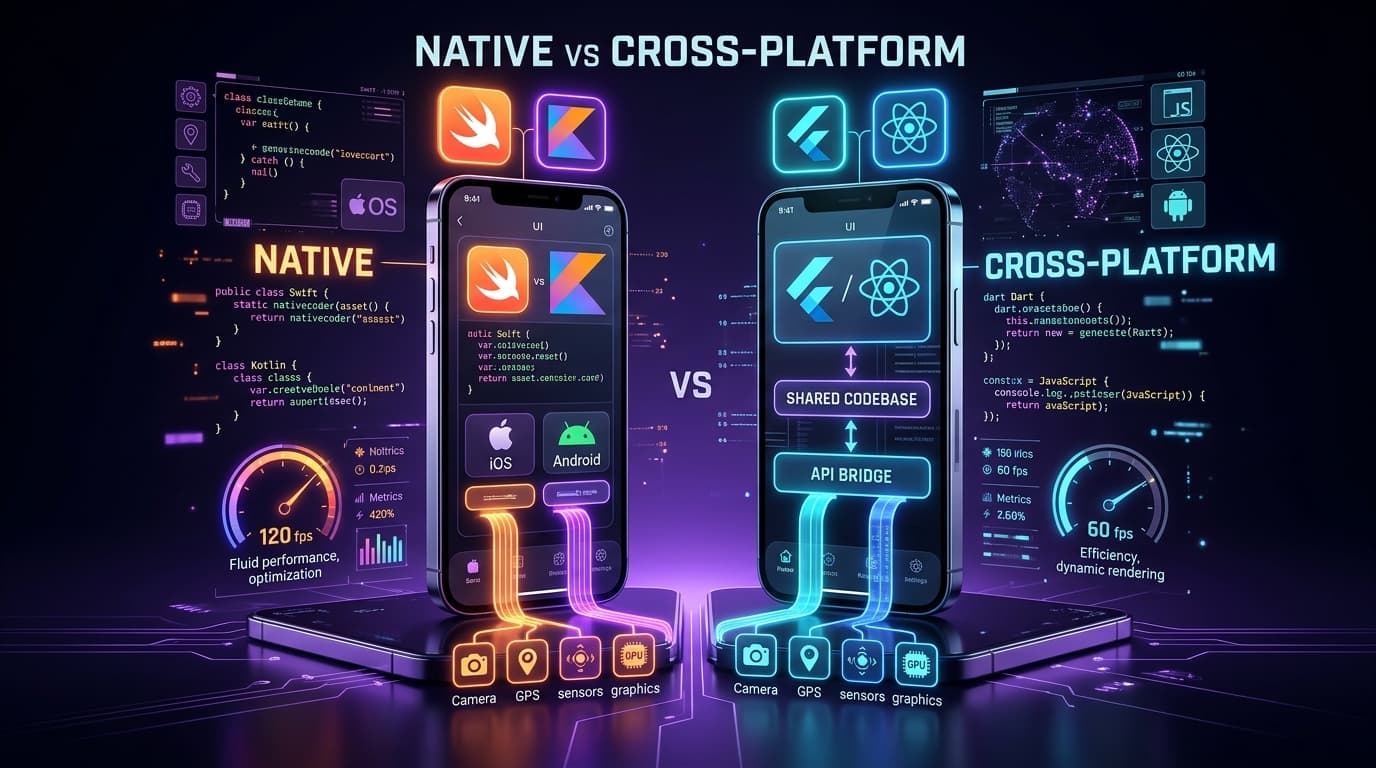
- ✓Modern cross-platform frameworks (Flutter and React Native) now power 90% of business applications with zero perceivable frame-rate drops.
- ✓Native development (Swift for iOS and Kotlin for Android) remains mandatory for low-level Bluetooth peripheral firmware updates, complex 3D gaming, and millimeter AR.
- ✓Cross-platform code sharing saves 35-45% in upfront development and drastically reduces long-term maintenance by maintaining a single business logic repository.
- ✓Flutter's Impeller GPU rendering engine compiles shaders ahead of time (AOT), eliminating shader compilation stutter on modern iOS devices.
Core Architectural Differences: Native vs Cross-Platform
When planning a commercial mobile product, selecting between native and cross-platform architecture is the most impactful technical fork in your development roadmap. The decision dictates not only your upfront development budget, but your long-term team structure, release cadence, and app performance profile.
Native Architecture (Swift / Objective-C for iOS, Kotlin / Java for Android): Native apps are written directly in the primary programming languages championed by Apple and Google. They communicate directly with underlying OS kernels, accessing device APIs without intermediary abstraction layers. However, this demands maintaining two completely separate codebases.
Cross-Platform Architecture (Flutter / React Native): Cross-platform frameworks allow engineers to author a unified application in a single language (Dart for Flutter, TypeScript for React Native) that compiles into native binaries or executes via optimized native rendering primitives across both operating systems.
Performance & Rendering Benchmarks (FPS, CPU, Battery)
Historically, cross-platform apps earned a reputation for sluggish frame rates and clunky scrolling. In 2026, architectural advances have fundamentally closed this performance gap:
| Metric | Native (Swift / Kotlin) | Flutter (Impeller Engine) | React Native (New Architecture) |
|---|---|---|---|
| Frame Rate (FPS) | Locked 60 / 120 FPS | Solid 60 / 120 FPS (AOT) | 58 – 60 FPS (Hermes JSI) |
| Cold App Startup Time | < 0.6 seconds | ~0.8 – 1.1 seconds | ~1.0 – 1.4 seconds |
| Binary Download Size | Minimal (~8 – 15 MB) | Moderate (~14 – 22 MB) | Moderate (~12 – 20 MB) |
| Code Reuse Percentage | 0% (Completely Separate) | 90% – 95% | 80% – 90% |
With Flutter's Impeller rendering engine now active across iOS and Android, shader compilation stutter has been solved. Pre-compiling shaders during build time guarantees that animations, page transitions, and complex gesture drags execute with fluid precision.
Hardware Sensors & Low-Level API Access
Where Native still maintains an edge is access to day-one OS platform features. When Apple or Google unveils new system APIs during WWDC or Google I/O, native developers can implement them immediately.
Cross-platform developers frequently rely on community plugins or write custom Native Platform Channels (MethodChannels in Flutter, TurboModules in React Native). For standard hardware integrations—such as Camera, GPS, Push Notifications, Accelerometers, and Biometrics—mature, production-grade plugins exist for both Flutter and React Native.
Development Speed & 3-Year Total Cost of Ownership
The business argument for cross-platform is overwhelming when examining the 3-year Total Cost of Ownership (TCO):
- Team Composition: Native requires two iOS engineers, two Android engineers, and two QA testers. Cross-platform requires two cross-platform engineers and one QA tester, reducing engineering payroll by approximately 45%.
- Release Velocity: New features, bug fixes, and API migrations are written once and pushed simultaneously to both the Apple App Store and Google Play Store.
- Unified Business Logic: Having identical client-side validation rules and caching logic eliminates platform-specific bugs where Android behaves differently from iOS.
Decision Matrix: When to Choose Native vs Cross-Platform
Choose Native (Swift & Kotlin) if:
- You are building a high-end 3D mobile game using Metal or Vulkan.
- Your app interfaces heavily with proprietary hardware peripherals via custom Bluetooth Low Energy (BLE) firmware protocols.
- You are engineering system-level utilities (custom keyboards, VPN clients, launcher widgets).
Choose Cross-Platform (Flutter / React Native) if:
- You are building an e-commerce, fintech, telemedicine, social, SaaS, or on-demand service application.
- You want to get an MVP to market rapidly within 8 to 12 weeks.
- You want to optimize capital efficiency without sacrificing visual polish or gesture fluidity.
Need guidance choosing the right framework? Speak with our Mobile Engineering Architects to evaluate your app's technical requirements.
Hardware Sensor API Access Matrix
Assess whether your application requires native platform channels or standard cross-platform plugins:
| Device Capability | Flutter (Plugins + Platform Channels) | React Native (TurboModules) | Native Swift / Kotlin |
|---|---|---|---|
| GPS Geofencing in Background | Excellent (geolocator plugin) | Excellent (react-native-geolocation) | Native CoreLocation / FusedLocation |
| Bluetooth LE Peripheral Firmware Sync | Good (flutter_blue_plus) | Moderate (react-native-ble-plx) | Unmatched low-level CoreBluetooth |
| Biometric FaceID / Fingerprint | Native speed (local_auth) | Native speed (react-native-biometrics) | LocalAuthentication framework |
Questions People Frequently Ask
Can users feel the difference between a Flutter app and a native app?
For 95% of consumer and business applications, users cannot distinguish between a properly optimized Flutter app and a native iOS/Android app. Flutter compiles directly to ARM machine code and uses its Impeller GPU rendering engine to maintain consistent 60fps and 120fps refresh rates without JavaScript bridges.
When is native mobile app development strictly required?
Native development is required when an application heavily relies on low-level device features like custom Bluetooth Low Energy (BLE) protocols, real-time audio synthesis, background geo-fencing with millimeter precision, intensive 3D gaming engines (Metal/Vulkan), or advanced ARKit/ARCore features.
Does cross-platform development make app updates faster?
Yes. With a cross-platform codebase, bug fixes, feature releases, and API schema updates are deployed once across both platforms simultaneously, cutting QA testing cycles and staging verification in half.
Written by Engineering Expert
Mr. Prakash Yadav
Prakash is the technical visionary and principal architect at BounceTech Solutions, specializing in mobile application development (Flutter, React Native, Swift, Kotlin), high-throughput cloud architectures, and Next.js full-stack engineering.
Keep Reading
Related Articles & Guides
 Mobile App Development
Flutter vs React Native in 2026: Speed, Performance & Total Cost Comparison
A head-to-head comparison between Google Flutter and Meta React Native for cross-platform iOS and Android mobile app development.
 Mobile App Development
 Cost in 2026: Complete Pricing & Budgeting Guide
From $18,000 MVPs to $160,000+ enterprise platforms, explore the definitive breakdown of mobile app development costs across iOS, Android, and cross-platform frameworks.
 Web Development
Next.js vs React in 2026: Which Framework Should You Choose for Your Business?
An in-depth technical and business comparison between Next.js and pure React to help you pick the right framework for scale and SEO.
Turn these architectural insights into reality.
Partner with BounceTech Solutions for custom software development, telemedicine apps, SaaS MVPs, and scalable cloud systems.