
How to Build Offline-First Mobile Apps: Data Sync, Local DBs & Conflict Resolution
When network drops in field operations, healthcare, or remote regions, your app cannot freeze. Learn how to architect zero-data-loss, local-first mobile applications.
Mr. Prakash Yadav
Co-Founder & CTO, BounceTech Solutions
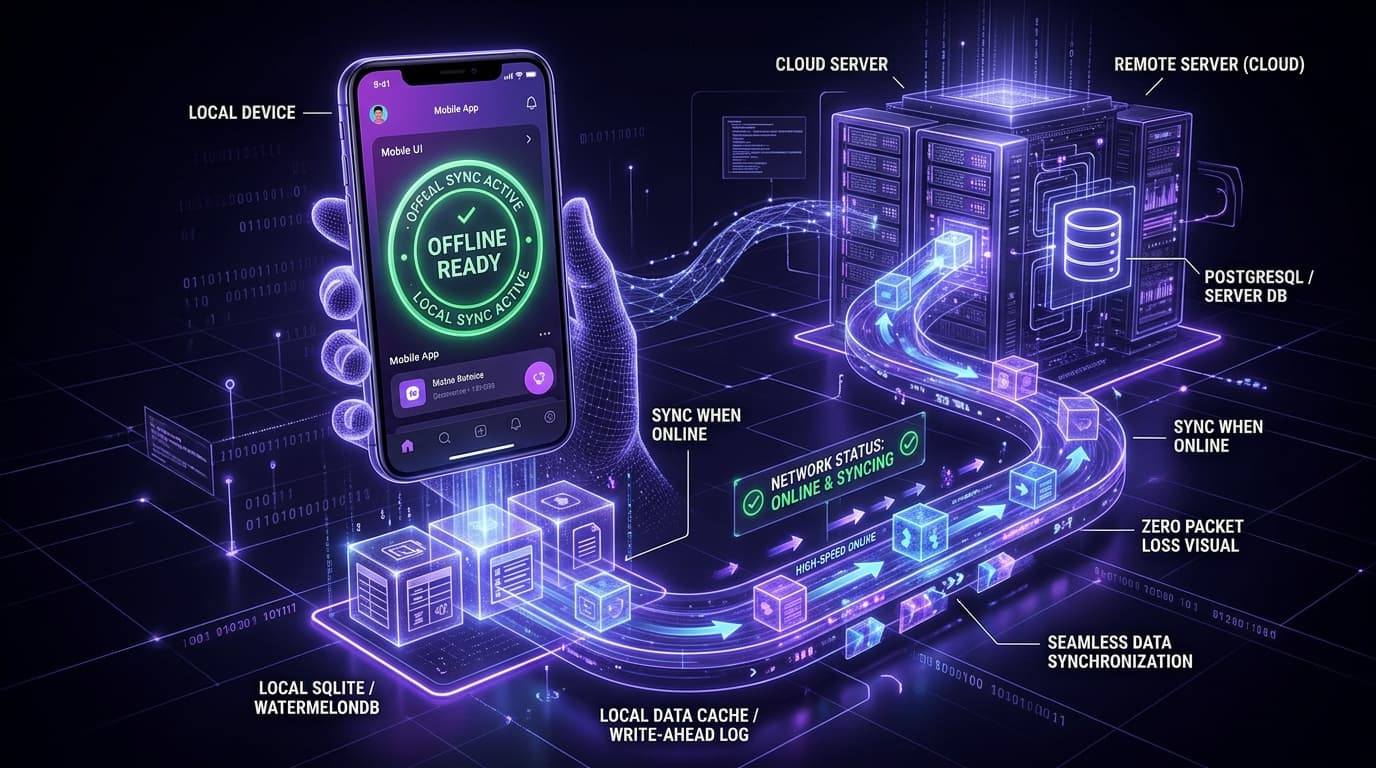
- ✓An offline-first architecture treats local on-device storage as the single source of truth for UI rendering, with the cloud server functioning as a background sync target.
- ✓Optimistic UI updates give users instantaneous sub-16ms feedback by mutating local state before network confirmation.
- ✓For apps handling tens of thousands of records, WatermelonDB (React Native) and SQLite with Drift (Flutter) provide lazy-loading and multi-threaded queries.
- ✓Conflict resolution requires deterministic strategies: Last-Write-Wins (LWW) with vector clocks, three-way base merges, or Conflict-Free Replicated Data Types (CRDTs).
Why Traditional Online-Only Apps Fail in the Real World
Most mobile applications are built around a fragile architectural assumption: the device always has a high-speed, stable internet connection. In the real world, users pass through underground subways, enter hospital basements with RF shielding, board airplanes, or operate in rural logistics hubs.
When an online-only app encounters network latency or packet drop, it freezes: spinners spin indefinitely, form submissions fail, and user data is lost. For mission-critical platforms in logistics, clinical healthcare, field service management, and POS systems, data loss directly translates into financial liability.
The Local-First Data Flow & Architecture Blueprint
An offline-first architecture flips the traditional client-server paradigm upside down. Instead of querying a remote API and storing state in transient memory, the application treats the local embedded database as the primary source of truth.
The standard local-first data lifecycle proceeds as follows:
- Immediate Local Write: When a user creates or updates a record, it is written immediately to the local embedded database (SQLite/WatermelonDB/Realm).
- Optimistic UI Render: The UI updates instantaneously (< 16 milliseconds) from the local database without waiting for network confirmation.
- Mutation Enqueue: The mutation is appended to a persistent local sync queue with a unique UUID, timestamp, and entity version tag.
- Background Synchronization: A background worker detects network connectivity, batches pending mutations, and pushes them to the cloud backend.
- Server Reconciliation: The backend verifies permissions, runs conflict resolution algorithms, updates the primary database, and broadcasts delta updates back to the client.
Embedded DB Shootout: SQLite vs WatermelonDB vs Realm
Choosing the right local embedded database depends on your framework and dataset volume:
| Database Engine | Best For | Query Speed (50k rows) | Key Architectural Advantage |
|---|---|---|---|
| SQLite (with Drift / Room) | Flutter & Native iOS/Android | Fast (~18ms) | Battle-tested, ACID compliant, native C engine embedded in every iOS/Android device. |
| WatermelonDB | React Native | Ultra-Fast (~12ms) | Lazy loading architecture; only loads records actively rendered on screen, keeping JS thread unblocked. |
| Realm (Atlas Device SDK) | Cross-Platform Object Storage | Moderate (~28ms) | Pure object-oriented database; eliminates ORM mapping boilerplate. |
Data Synchronization & Conflict Resolution Patterns
What happens when two users modify the exact same medical record or inventory count while both devices are offline? You need deterministic conflict resolution:
1. Last-Write-Wins (LWW): The record with the latest monotonic timestamp wins. While simple to implement, LWW risks silently overwriting concurrent edits made on different devices.
2. Three-Way Merge with Base Revision: The client sends the new value along with the original base version it read. If the server detects the base version has already changed, it flags a conflict and prompts the user or invokes custom business logic.
3. Conflict-Free Replicated Data Types (CRDTs): The modern gold standard for collaborative offline systems. By structuring data into state-based or operation-based CRDTs, conflicting operations merge mathematically without requiring centralized lock coordination.
Optimistic UI Updates & Persistent Background Queues
To deliver a fluid experience, applications must manage pending mutations using persistent background queues:
- Persistent Queue Storage: Never store pending sync requests in memory. If the user closes the app or the device runs out of battery, in-memory queues vanish. Store pending mutations in an encrypted SQLite table.
- Exponential Backoff & Jitter: When the backend server experiences high load or network connectivity is unstable, the sync worker should retry failed payloads using exponential backoff (e.g., retry after 2s, 4s, 8s, 16s) with randomized jitter to prevent thundering herd spikes.
Building an enterprise app requiring rock-solid offline reliability? Consult our Custom Software Engineering Specialists to architect your synchronization pipelines.
Persistent Mutation Queue Architecture (Dart / Flutter)
Never rely on memory queues. Write pending mutations into persistent on-device SQLite tables:
// Offline Mutation Queue with Drift SQLite & Exponential Backoff
import 'package:drift/drift.dart';

class OfflineMutations extends Table {
  TextColumn get id => text()(); // UUID v4
  TextColumn get endpoint => text()();
  TextColumn get payload => text()(); // JSON string
  IntColumn get attemptCount => integer().withDefault(const Constant(0))();
  DateTimeColumn get createdAt => dateTime()();

  @override
  Set<Column> get primaryKey => {id};
}

class SyncManager {
  Future<void> processPendingQueue(MyDatabase db, ApiClient client) async {
    final pending = await (db.select(db.offlineMutations)..orderBy([(t) => OrderingTerm.asc(t.createdAt)])).get();

    for (final mutation in pending) {
      try {
        await client.post(mutation.endpoint, data: mutation.payload);
        // Delete upon successful 200 OK server confirmation
        await (db.delete(db.offlineMutations)..where((t) => t.id.equals(mutation.id))).go();
      } catch (err) {
        // Increment attempts and schedule exponential retry
        await (db.update(db.offlineMutations)..where((t) => t.id.equals(mutation.id)))
            .write(OfflineMutationsCompanion(attemptCount: Value(mutation.attemptCount + 1)));
        break; // Stop processing to preserve sequential order
      }
    }
  }
}
Sequential processing ensures that an update to a record is never executed on the backend before the record's creation mutation completes.
Questions People Frequently Ask
What is an offline-first mobile application?
An offline-first mobile application stores all user data locally on the device (using embedded databases like SQLite or WatermelonDB), allowing full functionality without internet connectivity. When connectivity is restored, a background sync engine bi-directionally synchronizes and resolves changes with the cloud server.
How do offline mobile apps handle conflicting data changes?
Offline apps handle conflicts using deterministic algorithms: Last-Write-Wins (LWW) utilizing monotonic timestamps, three-way merges with base revision tracking, or mathematically provable Conflict-Free Replicated Data Types (CRDTs) that merge conflicting changes without human intervention.
Does an offline-first architecture increase mobile app build cost?
Yes. Architecting an offline-first synchronization engine typically adds 20% to 30% to backend and mobile engineering time due to complex queue management, state reconciliation, and edge-case testing, but it drastically reduces user churn and data loss in mission-critical field operations.
Written by Engineering Expert
Mr. Prakash Yadav
Prakash is the technical visionary and principal architect at BounceTech Solutions, specializing in mobile application development (Flutter, React Native, Swift, Kotlin), high-throughput cloud architectures, and Next.js full-stack engineering.
Keep Reading
Related Articles & Guides
 Software Development
How to Build a Modern Clinic Management & Telemedicine Platform (HIPAA Guide)
Everything you need to know about engineering a secure, HIPAA-compliant clinic management system with digital EMR, automated appointments, and teleconsultations.
 Mobile App Development
Flutter vs React Native in 2026: Speed, Performance & Total Cost Comparison
A head-to-head comparison between Google Flutter and Meta React Native for cross-platform iOS and Android mobile app development.
 Cloud Computing
Microservices vs Monolith: Choosing the Right Backend Architecture for Scalability
A practical engineering guide comparing microservices and monolithic architectures. Learn when to split, when to stay monolithic, and how to avoid distributed system pitfalls.
Turn these architectural insights into reality.
Partner with BounceTech Solutions for custom software development, telemedicine apps, SaaS MVPs, and scalable cloud systems.