
How to Build a Secure FinTech App: Architecture, PCI-DSS & KYC Compliance
Engineering a financial application requires zero room for error. Discover how to architect tamper-proof payment flows, integrate Plaid and Stripe, satisfy PCI-DSS, and prevent fraud.
BounceTech Engineering Team
Full-Stack & Cloud Engineering Team
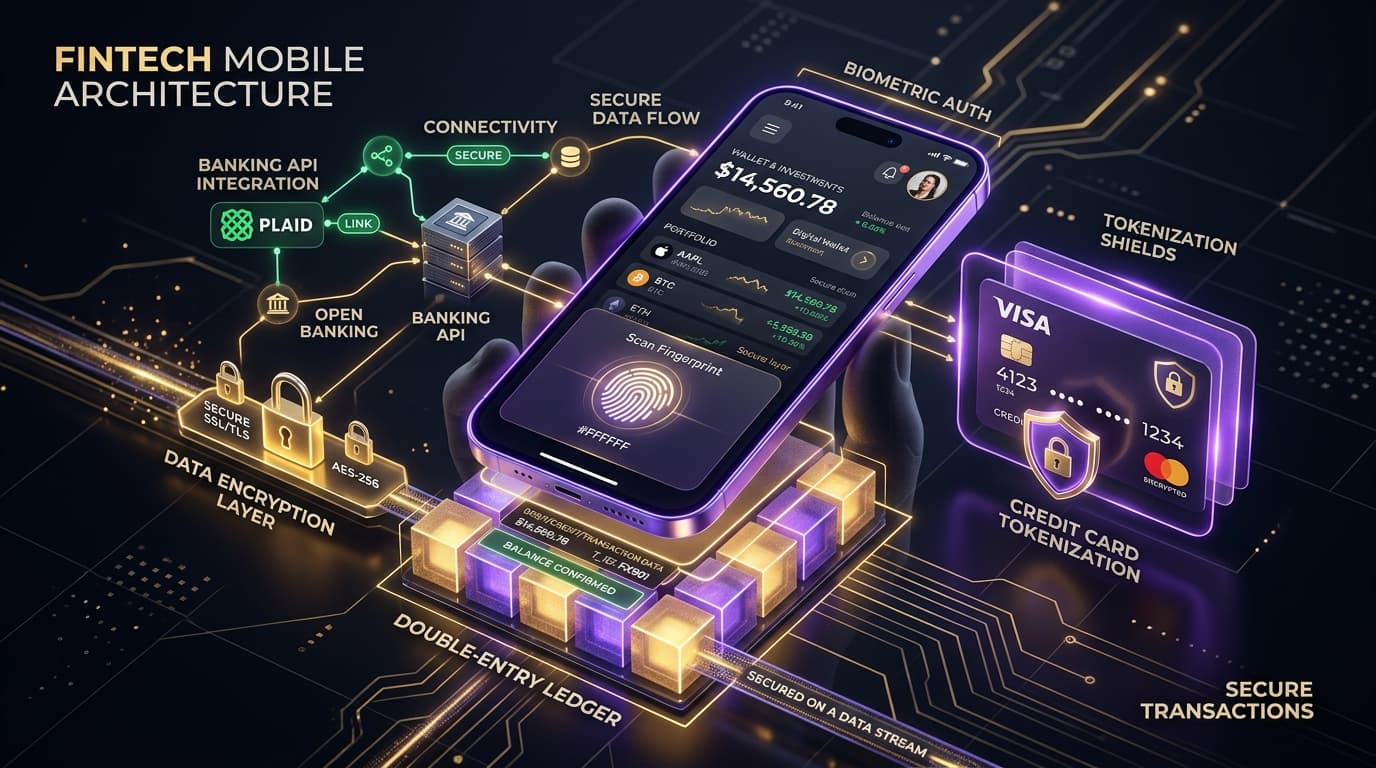
- ✓PCI-DSS Level 1 compliance mandates tokenization—never allow raw unencrypted credit card numbers (PANs) to touch your application databases or logs.
- ✓Automated KYC/AML verification using biometric liveness checks (e.g. Persona/Onfido) reduces fraudulent onboarding by over 95% while maintaining sub-60s verification.
- ✓Banking APIs (Plaid, MX) require OAuth 2.0 token exchange and mutual TLS (mTLS) to secure open banking data in transit.
- ✓Implement immutable double-entry ledger database architecture to guarantee mathematical balance between credits and debits across all transactions.
The Zero-Trust Architecture of Modern FinTech Apps
Building a financial technology application—whether a neobank, peer-to-peer lending portal, investment robo-advisor, or digital wallet—requires engineering under a strict Zero-Trust security model. A single security breach or data compromise can destroy customer trust and trigger millions of dollars in regulatory fines.
1. PCI-DSS Compliance & Cardholder Data Tokenization
If your application processes card payments, you are subject to the Payment Card Industry Data Security Standard (PCI-DSS). Storing raw 16-digit Primary Account Numbers (PANs) on your database exposes your firm to maximum audit scrutiny (PCI-DSS Level 1).
The Solution: Tokenization: Utilize client-side SDKs (Stripe Elements, Adyen Drop-in) where payment details are transmitted directly to a certified Level 1 vault. The client receives an opaque, single-use token (e.g. tok_1N2e34...) which your backend server stores to charge customer transactions without sensitive card numbers ever touching your servers.
2. KYC/AML Pipelines: Biometric Liveness & Sanctions Screening
Regulatory frameworks (FINCEN, Patriot Act, GDPR) mandate Know Your Customer (KYC) and Anti-Money Laundering (AML) checks before users can transact:
- Biometric Liveness Verification: Capture government ID scans paired with real-time 3D selfie video checks (using providers like Persona or Onfido) to prevent synthetic identity fraud.
- Automated Sanctions & PEP Screening: Automatically check user names against global OFAC and Politically Exposed Persons (PEP) watchlists during onboarding.
3. Open Banking Integrations: Plaid, Stripe & mTLS Protocols
Modern FinTech applications interface with established banking rails via Open Banking APIs:
- Plaid / MX: Secure ACH bank account verification and real-time balance checks without requiring users to input micro-deposit numbers manually.
- Mutual TLS (mTLS): All server-to-server banking API calls enforce mutual cryptographic authentication where both client and server present verified X.509 digital certificates.
4. Database Architecture: Double-Entry Ledgers & Event Sourcing
Never track financial balances using simple mutable fields like user.balance += 50. A network timeout or server crash during that update causes immediate accounting discrepancies.
Immutable Double-Entry Accounting: Every financial transaction must be recorded as two balancing entries: a debit and a credit. The sum of all debits must mathematically equal the sum of all credits at all times. Using an Event Sourcing pattern ensures an immutable, tamper-proof history of every cent that has ever flowed through the system.
5. Real-Time Fraud Prevention & Anomaly Detection
Deploy real-time anomaly detection pipelines that evaluate transaction velocity, device IP geographical jumps, and anomalous withdrawal sizes, placing flagged accounts into temporary manual verification queues before funds settle. Explore our FinTech & Enterprise Software Development Services.
Double-Entry Ledger SQL Schema (PostgreSQL)
Financial ledger databases must enforce mathematical balance using database-level constraints:
-- Immutable Double-Entry Ledger Schema in PostgreSQL
CREATE TABLE ledger_transactions (
    id UUID PRIMARY KEY DEFAULT gen_random_uuid(),
    reference_id VARCHAR(64) UNIQUE NOT NULL,
    description TEXT NOT NULL,
    created_at TIMESTAMP WITH TIME ZONE DEFAULT NOW() NOT NULL
);

CREATE TABLE ledger_entries (
    id UUID PRIMARY KEY DEFAULT gen_random_uuid(),
    transaction_id UUID REFERENCES ledger_transactions(id) ON DELETE RESTRICT,
    account_id UUID NOT NULL,
    amount_cents BIGINT NOT NULL, -- Positive for Debit, Negative for Credit
    currency VARCHAR(3) DEFAULT 'USD' NOT NULL,
    created_at TIMESTAMP WITH TIME ZONE DEFAULT NOW() NOT NULL
);

-- Constraint: A transaction is only committed if sum(amount_cents) == 0
CREATE OR REPLACE FUNCTION verify_ledger_balance() RETURNS TRIGGER AS $$
BEGIN
    IF (SELECT SUM(amount_cents) FROM ledger_entries WHERE transaction_id = NEW.transaction_id) != 0 THEN
        RAISE EXCEPTION 'Transaction is unbalanced: Debits and Credits must sum to zero';
    END IF;
    RETURN NEW;
END;
$$ LANGUAGE plpgsql;
This guarantees that funds can never be created or destroyed due to unexpected application crashes or unhandled exceptions.
Questions People Frequently Ask
How much does it cost to build a secure FinTech application?
Building a compliant FinTech application typically ranges from $65,000 to $180,000+ depending on whether it requires digital wallet capabilities, banking API rails (Plaid), or investment brokerage integrations.
What is PCI-DSS compliance in mobile and web apps?
Payment Card Industry Data Security Standard (PCI-DSS) is a set of technical security requirements designed to protect cardholder data. By using client-side tokenization (such as Stripe Elements or Braintree SDKs), apps avoid storing sensitive card numbers on their servers, drastically reducing compliance audit scope.
How do FinTech apps securely connect to bank accounts?
FinTech apps connect to financial institutions using open banking aggregators (Plaid, MX, Yodlee) utilizing OAuth 2.0 tokenization. The user authenticates directly with their bank portal, and the app receives an encrypted access token with read-only access to balances and transaction histories.
Written by Engineering Expert
BounceTech Engineering Team
The core engineering division at BounceTech Solutions, dedicated to building production-grade software architectures, automated CI/CD pipelines, and high-performance digital products.
Keep Reading
Related Articles & Guides
 Software Development
How to Build a Modern Clinic Management & Telemedicine Platform (HIPAA Guide)
Everything you need to know about engineering a secure, HIPAA-compliant clinic management system with digital EMR, automated appointments, and teleconsultations.
 Software Development
Custom Software Development Cost in 2026: Complete Global Pricing Guide
A comprehensive pricing guide detailing the actual costs of building custom web apps, mobile solutions, and enterprise SaaS platforms in 2026.
 Cybersecurity
Mobile App Security Best Practices: The OWASP Mobile Top 10 Guide
From client-side decompilation to man-in-the-middle attacks, learn how senior mobile engineers secure Flutter, React Native, and native iOS/Android applications.
Turn these architectural insights into reality.
Partner with BounceTech Solutions for custom software development, telemedicine apps, SaaS MVPs, and scalable cloud systems.