
On-Device AI in Mobile Apps: Running Local LLMs with CoreML & TensorFlow Lite
Cloud AI APIs cost thousands per month in GPU token bills and introduce 800ms network latency. Learn how on-device AI runs local LLMs and vision models privately with zero cloud fees.
Mr. Prakash Yadav
Co-Founder & CTO, BounceTech Solutions
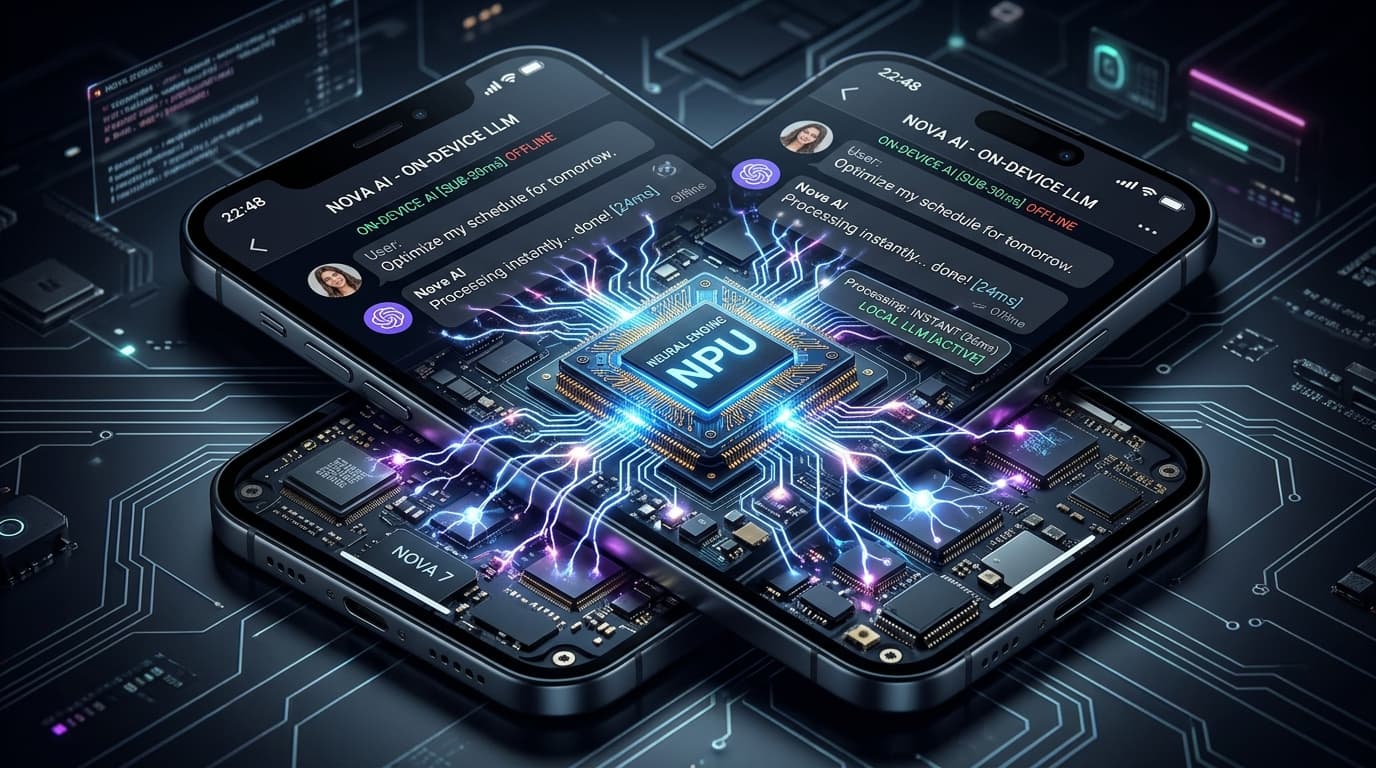
- ✓On-device AI executes machine learning models directly on Apple Neural Engines (NPU) and Qualcomm Hexagon chips with zero cloud API token expenses.
- ✓Local inference provides sub-50ms latency and 100% offline functionality, making it ideal for real-time camera scanning, transcription, and predictive text.
- ✓Model quantization (4-bit and 8-bit int precision) reduces multi-gigabyte models into lightweight 50MB to 400MB footprints without catastrophic accuracy loss.
- ✓Zero user data leaves the physical device, satisfying strict HIPAA, GDPR, and enterprise privacy regulations out-of-the-box.
Why On-Device AI is Outpacing Cloud APIs
For the past three years, generative AI development was synonymous with sending HTTP requests to centralized cloud APIs (OpenAI, Anthropic, Gemini). While cloud models are massive, relying on them for mobile applications introduces three catastrophic friction points:
- Skyrocketing Cloud Token Costs: Paying $0.005 to $0.03 per 1k tokens destroys margins when scaled across hundreds of thousands of active mobile users.
- Unacceptable Latency: A network round-trip plus cloud queueing introduces 600ms to 2,000ms latency—far too sluggish for real-time speech translation, camera object classification, or interactive autocomplete.
- Privacy & Regulatory Friction: Enterprise clients in healthcare, legal, and financial sectors often prohibit transmitting proprietary end-user data to third-party cloud servers.
On-Device AI solves all three problems: inference runs on the phone's silicon with zero token fees, sub-30ms response times, and complete data sovereignty.
Mobile Hardware Acceleration: Apple Neural Engine & Qualcomm NPUs
Modern smartphones are no longer generic computers; they are specialized AI hardware accelerators. Apple Silicon features a 16-core Apple Neural Engine (ANE) capable of up to 38 trillion operations per second (TOPS), while Qualcomm Snapdragon chips feature dedicated Hexagon NPUs. Routing compute through dedicated neural silicon delivers 10x higher energy efficiency compared to running machine learning routines on CPU or GPU cores, preventing thermal throttling and battery drain.
Framework Comparison: Apple CoreML vs. TensorFlow Lite / ONNX
| Feature | Apple CoreML 3 / 4 | TensorFlow Lite / ExecuTorch |
|---|---|---|
| Target Platforms | iOS, iPadOS, macOS, watchOS only | Cross-platform (Android, iOS, Embedded Linux) |
| Hardware Dispatch | Automatic dynamic routing across ANE, GPU, and CPU | Configurable delegates (NNAPI, GPU, Hexagon NPU) |
| Quantization Support | Palettization, linear INT8, INT4 quantization | Post-training dynamic & integer quantization |
Model Quantization: Compressing LLMs from 4GB to 400MB
A standard 7B parameter model stored in 16-bit floating point precision (FP16) requires ~14GB of memory—vastly exceeding the available RAM on mobile devices. Quantization maps continuous floating-point weights into lower-bit discrete representations (INT8 or INT4):
- INT8 Quantization: Reduces model size by 50% with negligible (< 1%) perplexity loss.
- INT4 Quantization: Compresses a 2B parameter model (e.g. Gemma 2B or SmolLM) down to ~350MB, fitting comfortably inside mobile RAM and executing at 18–25 tokens/second on an iPhone 16.
Production Use Cases: Audio, Vision & Local Text
Real-world applications deploying edge AI achieve dramatic competitive advantages:
- Local Voice Transcription (Whisper Tiny): Transcribe patient consultations or field notes into formatted text with zero internet connection.
- On-Device OCR & Document Parsing: Extract invoice line items and receipt data in real time via live camera feeds.
- Smart Semantic Search: Generate local vector embeddings using MobileBERT directly inside mobile SQLite databases for private search. Explore our Custom AI Engineering Solutions to architect edge intelligence into your product.
CoreML Model Quantization Pipeline (Python)
Convert PyTorch or HuggingFace transformers into lightweight Apple Neural Engine packages:
# Python: Quantizing an LLM to 4-bit CoreML Package
import coremltools as ct
from coremltools.models.neural_network import quantization_utils

# Convert base model to CoreML Float16
mlmodel = ct.convert(
    pytorch_model,
    inputs=[ct.TensorType(name="input_ids", shape=(1, 512))],
    compute_units=ct.ComputeUnit.ALL # Dispatches across Neural Engine, GPU, and CPU
)

# Apply 4-bit linear quantization to compress weights by 75%
quantized_model = quantization_utils.quantize_weights(mlmodel, nbits=4)
quantized_model.save("LocalMobileAssistant_4bit.mlpackage")
print("Successfully compiled sub-400MB on-device model.")
This enables on-device chat and semantic search without consuming excessive mobile memory.
Questions People Frequently Ask
Can a mobile phone run a Large Language Model (LLM) locally?
Yes. Modern mobile chips (Apple A17/A18, Snapdragon 8 Gen 3/4) feature dedicated Neural Processing Units (NPUs) capable of running quantized 1B to 3B parameter models (such as Llama 3.2 1B or Gemma 2 2B) at 15 to 25 tokens per second completely offline.
What is the difference between CoreML and TensorFlow Lite?
CoreML is Apple's proprietary framework, deeply optimized for iOS hardware to route compute across GPU, CPU, and Apple Neural Engine. TensorFlow Lite is Google's cross-platform runtime for Android and iOS that compiles models into lightweight FlatBuffers.
Does running AI models on mobile drain the battery quickly?
If run on generic CPU cores, AI inference causes significant battery drain and thermal throttling. However, routing inference through dedicated NPUs (Neural Processing Units) delivers up to 10x higher energy efficiency, allowing sustainable real-time inference.
Written by Engineering Expert
Mr. Prakash Yadav
Prakash is the technical visionary and principal architect at BounceTech Solutions, specializing in mobile application development (Flutter, React Native, Swift, Kotlin), high-throughput cloud architectures, and Next.js full-stack engineering.
Keep Reading
Related Articles & Guides
 Artificial Intelligence
Agentic AI in Software Development: How Autonomous Agents Are Transforming Engineering Workflows in 2026
From basic autocomplete to autonomous multi-agent engineering teams: how Agentic AI is revolutionizing software architecture, code generation, and test automation.
 Mobile App Development
 Cost in 2026: Complete Pricing & Budgeting Guide
From $18,000 MVPs to $160,000+ enterprise platforms, explore the definitive breakdown of mobile app development costs across iOS, Android, and cross-platform frameworks.
 Mobile App Development
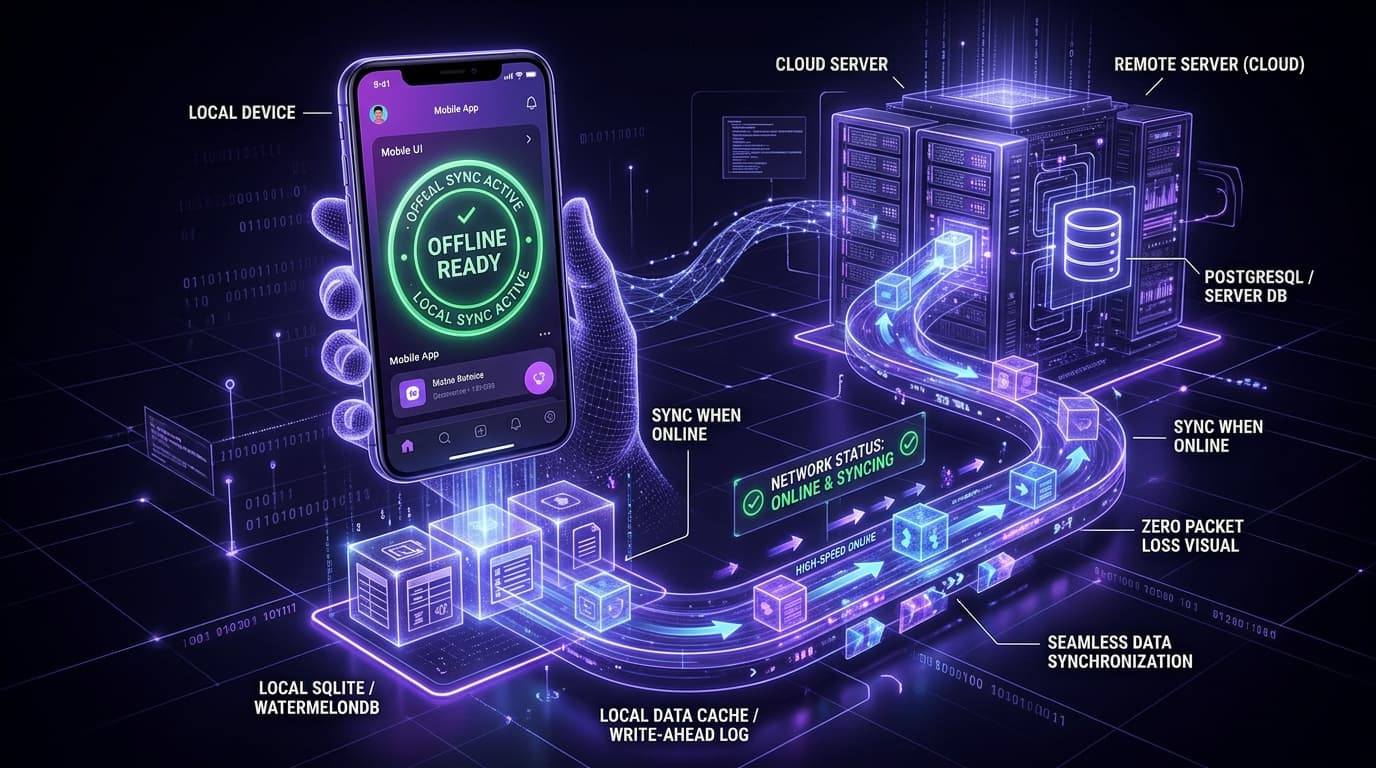
How to Build Offline-First Mobile Apps: Data Sync, Local DBs & Conflict Resolution
When network drops in field operations, healthcare, or remote regions, your app cannot freeze. Learn how to architect zero-data-loss, local-first mobile applications.
Turn these architectural insights into reality.
Partner with BounceTech Solutions for custom software development, telemedicine apps, SaaS MVPs, and scalable cloud systems.